1. Introduction
Public cryptocurrency networks like Bitcoin rely on a decentralized ledger. The core challenge is achieving consensus without a central authority while preventing Sybil and double-spending attacks. Bitcoin's seminal solution was the integration of Hashcash-style Proof of Work (PoW), which imposes a verifiable economic cost on participants (miners) to secure the network and distribute new currency.
1.1 Proof of Work in the Context of Blockchains
Proof of Work, initially proposed by Dwork and Naor (1992), involves solving a cryptopuzzle that requires significant computational effort but is trivial to verify. In blockchain, this "work" secures the network by making it economically impractical for an attacker to rewrite transaction history.
2. The Problem with Traditional PoW
The primary cost of Hashcash-based mining (like Bitcoin's SHA256) is electricity (Operating Expense - OPEX). This has led to:
- Scalability Issues: Massive energy consumption limits network growth.
- Environmental Concerns: Significant carbon footprint.
- Centralization Risks: Mining concentrates in regions with cheap electricity, creating geographical single points of failure and reducing censorship resistance.
- Price Volatility Sensitivity: Hashrate is highly sensitive to cryptocurrency price, as miners shut down when operational costs exceed rewards.
3. Optical Proof of Work (oPoW) Concept
The authors propose oPoW as a novel algorithm that shifts the dominant cost of mining from electricity (OPEX) to specialized hardware (Capital Expense - CAPEX). The core insight is that PoW security requires an economic cost, but that cost need not be primarily energy.
3.1 Algorithm Overview
oPoW is designed as a minimal modification to Hashcash-like schemes. It retains the structure of finding a nonce such that $\text{H}(\text{block header} || \text{nonce}) < \text{target}$, but optimizes the computation for a specific hardware paradigm: silicon photonics. The algorithm is tuned so that performing the work efficiently requires a photonic co-processor, making general-purpose hardware (like ASICs or GPUs) economically non-competitive.
3.2 Hardware: Silicon Photonic Co-processors
The algorithm leverages advances in silicon photonics—integrated circuits that use photons (light) instead of electrons for computation. These co-processors, recently commercialized for low-energy deep learning, offer orders of magnitude better energy efficiency for specific linear algebra operations. oPoW's cryptopuzzle is designed to map efficiently onto these photonic operations.
4. Advantages and Potential Impact
- Energy Savings: Dramatically reduces the electricity consumption of mining.
- Improved Decentralization: Mining is no longer tied to ultra-low electricity costs, enabling geographic spread and increased censorship resistance.
- Enhanced Network Stability: With CAPEX dominating, hashrate becomes less sensitive to short-term coin price fluctuations, leading to a more stable security budget.
- Democratized Issuance: Lower ongoing costs could lower barriers to entry for smaller miners.
5. Technical Details & Mathematical Foundation
The paper suggests oPoW relies on computational problems that are inherently fast on photonic hardware. A potential candidate involves iterative matrix operations or optical transforms that are difficult to emulate efficiently on electronic hardware. The verification remains simple, akin to checking a standard hash: $\text{Verify}(\text{solution}) = \text{true}$ if $\text{H}_{\text{oPoW}}(\text{challenge}, \text{solution})$ meets the target criteria. The function $\text{H}_{\text{oPoW}}$ is constructed to be computed most efficiently on a photonic systolic array or interferometric mesh.
6. Prototype & Experimental Results
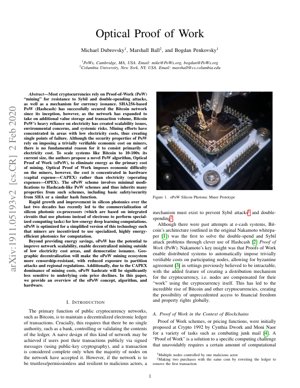
The paper references a prototype (Figure 1). While specific performance metrics are not detailed in the provided excerpt, the implication is that a silicon photonic chip can compute the oPoW function. The key experimental claim is the demonstration of functional correctness and a significant performance-per-watt advantage over electronic ASICs for the tailored computation. The results would aim to show that the energy per hash is drastically lower, validating the core thesis of shifting cost from OPEX to CAPEX.
Chart Description (Implied): A bar chart comparing Energy per Hash (Joules) for SHA256 ASICs vs. oPoW Photonic Processor. The oPoW bar would be orders of magnitude shorter, visually emphasizing the energy efficiency gain.
7. Analysis Framework: A Non-Code Case Study
Case: Evaluating a Proposed Fork to oPoW. An analyst assessing a cryptocurrency considering an oPoW fork would examine:
- Economic Shift: Model the new miner economics. What is the CAPEX for a photonic miner? What is its lifespan and residual value? How does profitability compare to traditional mining across coin price cycles?
- Security Transition: Analyze the hashrate transition period. Would the network be vulnerable during a switch from electronic to photonic miners? How is the difficulty algorithm adjusted?
- Supply Chain & Manufacturing: Assess the risk of centralization in photonic chip fabrication (e.g., dependent on a few semiconductor fabs). Is the hardware sufficiently commoditizable?
- Algorithm Rigidity: Evaluate if the oPoW algorithm is so specialized that it cannot be easily tweaked if a vulnerability is found, unlike cryptographic hash functions which have broad scrutiny.
8. Future Applications & Development Roadmap
- New Cryptocurrencies: Primary application is in the design of new, energy-sustainable blockchains.
- Existing Chain Forks: Potential for established coins (e.g., Bitcoin forks) to adopt oPoW to address environmental criticisms.
- Hybrid PoW Schemes: Combining oPoW with other mechanisms (e.g., Proof-of-Stake elements) for layered security.
- Hardware Evolution: Drives R&D in accessible, standardized photonic co-processor platforms, similar to the GPU and ASIC evolution in traditional mining.
- Regulatory Greenwashing Shield: Could become a key technology for cryptocurrencies to comply with or pre-empt energy-focused regulations.
9. References
- Nakamoto, S. (2008). Bitcoin: A Peer-to-Peer Electronic Cash System.
- Back, A. (2002). Hashcash - A Denial of Service Counter-Measure.
- Dwork, C., & Naor, M. (1992). Pricing via Processing or Combatting Junk Mail. CRYPTO '92.
- Miller, D. A. B. (2017). Attojoule Optoelectronics for Low-Energy Information Processing and Communications. Journal of Lightwave Technology.
- Zhu, X., et al. (2022). Photonic Matrix Processing for Machine Learning. Nature Photonics.
10. Analyst's Perspective
Core Insight: oPoW isn't just an efficiency tweak; it's a fundamental re-architecting of crypto-economic security. The authors correctly identify that PoW's security is rooted in economic cost, not energy cost. Their attempt to decouple the two by anchoring cost in specialized photonic CAPEX is a bold and necessary direction for the sustainability of permissionless blockchains. It directly attacks the biggest PR and scaling nightmare of cryptocurrencies like Bitcoin.
Logical Flow: The argument is compelling: 1) Traditional PoW's energy dependence is a fatal flaw for mass adoption. 2) The security primitive is economic cost, not joules. 3) Silicon photonics offer a path to massive efficiency gains for specific computations. 4) Therefore, design a PoW algorithm that is optimal for photonics. The logic is sound, but the devil is in the technical and economic implementation details not fully fleshed out in the abstract.
Strengths & Flaws: The strength is its visionary approach to a critical problem, backed by a tangible hardware trend (silicon photonics for AI). It has the potential to alter the geopolitical map of mining. The flaws are significant: First, it risks replacing energy centralization with hardware manufacturing centralization. Fabricating advanced photonic ICs is arguably more centralized than finding cheap electricity. Who controls the fab? Second, it creates algorithmic fragility. SHA256 is battle-tested. A novel, hardware-tuned algorithm is a much smaller attack surface that may harbor unforeseen vulnerabilities, a concern echoed in the broader security community when evaluating new cryptographic primitives. Third, the economic model is untested. Will CAPEX-heavy mining truly be more decentralized and stable, or will it simply favor a different type of capital-rich entity?
Actionable Insights: For investors and developers, this is a high-risk, high-reward research track. Monitor the photonics industry closely—companies like Lightmatter, Luminous, or Intel's Silicon Photonics division. Their progress in commoditizing photonic computing is a leading indicator for oPoW's viability. Scrutinize the first full technical specification of an oPoW algorithm for its cryptographic soundness and resistance to simulation on electronic hardware. For existing projects, consider a hybrid model as a transitional step. Finally, this research should spur similar innovation: if the goal is CAPEX-based security, what other hardware paradigms (e.g., analog computing, memristor arrays) could be leveraged? The field must explore multiple paths beyond photonics to avoid swapping one dependency for another.