1. Introduction
Bitcoin's Nakamoto consensus, secured by sequential proof-of-work (PoW), revolutionized decentralized systems by enabling state replication without trusted identity. However, its security has largely been analyzed asymptotically, leaving users uncertain about concrete wait times for finality. This uncertainty is exploited by threats like double-spending and selfish mining.
Recent work by Li et al. (AFT '21) provided concrete security bounds for Bitcoin's sequential PoW. This paper by Keller and Böhme builds upon this by asking a fundamental question: Can non-sequential proof-of-work improve security? They answer affirmatively by proposing a principled family of state replication protocols based on parallel proof-of-work, where each block contains $k$ independent puzzles solved in parallel.
The key innovation is a bottom-up design starting from an agreement sub-protocol, enabling the derivation of concrete, bounded worst-case failure probabilities in adversarial synchronous networks. This allows for faster finality—potentially after just one block—significantly mitigating double-spending risks.
2. Core Concepts & Protocol Design
2.1 Sequential vs. Parallel Proof-of-Work
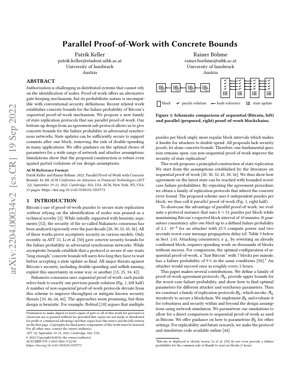
The fundamental architectural shift is moving from a chain (sequential) to a directed acyclic graph (DAG) inspired structure for puzzle references within a block.
- Sequential (Bitcoin): Each block contains one puzzle, and its solution hash points to exactly one previous block, forming a linear chain. Security relies on the longest chain rule.
- Parallel (Proposed): Each block contains $k$ independent puzzles. The block is valid when a sufficient threshold of these puzzles is solved. This creates multiple hash references per block (see Fig. 1 in the PDF).
This parallelism aims to regularize block arrival times and increase the "weight" or "work" per block, making it computationally harder for an adversary to overtake the honest chain in a short time window.
2.2 The Agreement Sub-Protocol Ak
The protocol family is constructed from a core agreement sub-protocol, denoted $A_k$. The parameter $k$ defines the number of parallel puzzles per block. The protocol operates in rounds:
- Tufatufaina o Puzzles: k puzzles cryptographic tuto'atasi e fa'amatalaina mo le poloka sui.
- La'uina Parallel: Miners work on all $k$ puzzles simultaneously.
- Threshold Achievement: The block is considered "found" and propagated when a predefined threshold of puzzle solutions (e.g., all $k$, or a majority) is collected.
- Agreement Rule: Honest nodes adopt the first valid block they see that meets the threshold condition, following a pre-defined tie-breaking rule.
Repeating $A_k$ forms the state replication protocol. The design's modularity allows for rigorous analysis of the single-round agreement probability.
2.3 Concrete Security Bounds Derivation
The paper's major contribution is providing upper bounds for the worst-case failure probability of protocol $A_k$. The analysis considers:
- Network Model: Synchronous network with a known maximum message delay $\Delta$.
- Adversary Model: Computationally bounded adversary controlling a fraction $\beta$ of the total hash power. The adversary can deviate arbitrarily (Byzantine).
- Honest Majority Assumption: Honest miners control hash power $\alpha > \beta$.
The failure probability $\epsilon$ is derived as a function of $k$, $\alpha$, $\beta$, $\Delta$, and the puzzle difficulty. The bound demonstrates that for a fixed total block time, increasing $k$ (and correspondingly adjusting individual puzzle difficulty) can exponentially decrease $\epsilon$.
2.4 Parameter Optimization Guidance
The authors provide methodology to choose optimal parameters ($k$, individual puzzle difficulty) for a target failure probability $\epsilon$, given network parameters ($\Delta$) and attacker strength ($\beta$).
Showcase Configuration
Target: Consistency after 1 block.
Parameters: $k=51$, total block interval = 10 min (Bitcoin equivalent), $\Delta=2s$, $\beta=25\%$.
Result: Guaranteed failure probability $\epsilon \leq 2.2 \cdot 10^{-4}$.
Interpretation: An attacker would need to attempt thousands of blocks for one successful consistency attack.
For comparison, they cite an optimized "fast Bitcoin" (7 blocks/min) under the same conditions having a $9\%$ failure probability, meaning an attacker succeeds roughly every 2 hours.
3. Technical Analysis & Results
3.1 Mathematical Framework & Formulas
The analysis models mining as a Poisson process. Let $\lambda_h$ and $\lambda_a$ be the block finding rates of the honest network and the adversary, respectively, for a single puzzle. For $k$ parallel puzzles, the effective rate for finding a full block (all $k$ solutions) changes.
A key formula involves the probability that the adversary can secretly mine a competing block that is longer (in terms of total puzzle solutions) than the honest chain during a vulnerability window. The bound takes a form reminiscent of the Chernoff bound, where the failure probability decays exponentially with a function of $k$ and the honest advantage $(\alpha - \beta)$.
Misalnya, probabilitas $P_{\text{fork}}$ bahwa penyerang membuat rantai pesaing dengan "bobot" yang sama selama putaran tertentu dapat dibatasi oleh: $$P_{\text{fork}} \leq \exp\left( -k \cdot f(\alpha, \beta, \Delta) \right)$$ di mana $f$ adalah fungsi positif yang berasal dari analisis kondisi balapan. Ini dengan jelas menunjukkan peningkatan keamanan eksponensial dari peningkatan $k$.
3.2 Experimental Setup & Simulation Results
The paper validates its theoretical bounds through simulations. The setup likely includes:
- A discrete-event simulator modeling miners, network delays ($\Delta$), and the parallel mining process.
- Scenarios varying $k$, $\beta$, and $\Delta$.
- Metrics: Observed failure rate (e.g., frequency of successful double-spends), block propagation regularity, chain growth.
Key Reported Result: The simulations confirm that the proposed construction is robust even against partial violations of the theoretical assumptions (e.g., slightly higher network latency or a transient increase in adversarial hash power). The observed failure rates in simulation stayed well below the theoretical upper bounds.
Chart Description (Inferred): A chart likely plots the logarithm of the failure probability $\epsilon$ on the Y-axis against the number of parallel puzzles $k$ on the X-axis, for different adversary powers $\beta$. The lines would show a steep, linear downward slope in the log plot, demonstrating exponential improvement. Another chart probably compares the time-to-finality (in blocks) for parallel PoW vs. sequential PoW to achieve the same $\epsilon$, showing a dramatic reduction for parallel PoW.
3.3 Performance Comparison: Parallel vs. Sequential PoW
The paper provides a compelling numerical comparison (summarized in their Table 3):
- Goal: Single-block finality (consistency).
- Condition: $\beta=25\%$, $\Delta=2s$.
- Parallel PoW ($k=51$): $\epsilon \approx 2.2 \times 10^{-4}$.
- Sequential "Fast Bitcoin" (7 blk/min): $\epsilon \approx 9 \times 10^{-2}$.
This represents an improvement in failure probability by a factor of over 400 times while maintaining the same average block production rate (10 min). The parallel protocol transforms a risky proposition (9% chance of failure) into a highly secure one (0.022% chance).
4. Critical Analysis & Expert Interpretation
Industry Analyst Perspective: This isn't just an incremental tweak; it's a fundamental re-architecting of Proof-of-Work that exposes the latent inefficiencies in Bitcoin's linear design. Here's my take.
4.1 Core Insight
The paper's genius lies in reframing the security problem from "longest chain" to "heaviest bundle of work." Bitcoin's sequential model is inherently stochastic and bursty—a security flaw disguised as a feature. Keller and Böhme recognize that what matters for finality isn't the number of blocks, but the irreversibility of accumulated work in a given time window. By parallelizing puzzles, they smooth out the Poisson distribution of block findings, making the system's progress more predictable and thus much harder to attack. This is akin to moving from a lottery (where one big win changes everything) to a salary (steady, predictable income). The attacker's job shifts from winning a single high-variance race to winning many simultaneous, lower-variance races—a statistically doomed endeavor.
4.2 Logical Flow
The argument is elegantly constructed: (1) Acknowledge that concrete bounds are the missing piece for real-world PoW applications. (2) Identify that sequential PoW's variance is the root cause of poor concrete performance. (3) Propose parallelism as a variance-reduction mechanism. (4) Build a minimal agreement primitive ($A_k$) to formally analyze this reduction. (5) Derive bounds showing exponential security gains in $k$. (6) Validate with simulations. The logic is watertight. It mirrors the approach in foundational consensus literature like the PBFT paper by Castro and Liskov, which also started with a core agreement protocol before building a full replication system.
4.3 Strengths & Flaws
Strengths:
- Quantifiable Security: The concrete bounds are a game-changer for enterprise adoption. You can now calculate insurance premiums for blockchain settlements.
- Faster Finality: Single-block finality for many applications removes a huge UX and business logic hurdle. This directly attacks DeFi's biggest pain point.
- Backwards-Compatible Concept: It's still pure PoW, avoiding the complexity and subjectivity of Proof-of-Stake. Miners can adapt their hardware.
Glaring Flaws & Questions:
- Communication Overhead: Propagating $k$ solutions per block increases bandwidth. The paper hand-waves this, but in practice, this could be crippling. A block with 51 headers isn't trivial.
- Centralization Pressure: Parallel mining might favor larger mining pools that can efficiently manage many concurrent puzzle computations, potentially worsening centralization—the very thing PoW aims to mitigate.
- Real-World Network Assumptions: The synchronous network model with a known $\Delta$ is notoriously optimistic. The Internet is partially synchronous at best. Their robustness claims against assumption violations need far more stress-testing.
- No Free Lunch: The improved security for a fixed total work rate likely comes from increased variance reduction, which itself might have other unintended consequences on miner incentives and empty block mining.
4.4 Actionable Insights
For protocol designers: This is a blueprint. Start experimenting with parallel PoW in sidechains or new L1s targeting high-value, fast-finality use cases (e.g., securities settlement). The parameter $k$ is a powerful new knob to tune. For miners: Begin evaluating software and hardware setups for parallel hash computation. The first pool to optimize for this could capture significant advantage. For investors: Watch for projects that cite this paper. It's a marker of serious cryptographic engineering, as opposed to the usual heuristic-driven forks. For critics: The onus is now on you. To dismiss parallel PoW, you must attack its specific bounds or demonstrate the overhead is fatal—vague appeals to "Bitcoin's proven security" no longer suffice. This work elevates the discourse from ideology to engineering.
5. Analysis Framework & Case Example
Framework for Evaluating a New PoW Protocol:
- Security Model: Define network synchrony ($\Delta$), adversary power ($\beta$), and corruption model (e.g., Byzantine).
- Core Primitive: Identify the smallest agreement unit (e.g., one round of $A_k$).
- Probability Analysis: Model the mining race as a stochastic process. Use probability theory (e.g., Poisson races, Chernoff bounds) to derive the probability of a safety violation (fork) within one round.
- Kompozisyon: Tek tur sınırını, Bitcoin omurga makalesindeki [Garay ve diğerleri] martingale analizi gibi teknikler kullanarak çoklu turlara (zincir büyümesi) genişletin.
- Parametre Optimizasyonu: For desired failure probability $\epsilon_{target}$ and known $\Delta, \beta$, solve for protocol parameters (e.g., $k$, puzzle difficulty).
- Simulation & Robustness Check: Test against model violations (e.g., variable $\Delta$, temporary $\beta$ spikes).
Case Example: Designing a Payment Channel Hub
Problem: A hub needs to finalize channel state updates quickly to prevent fraud.
Application of Framework:
- Model: Hub operators assume $\Delta < 5s$ (controlled environment), $\beta < 30\%$.
- Target: State update finality in 30 seconds with $\epsilon < 10^{-6}$.
- Analysis: Use the parallel PoW formulas. Calculate that with a total work rate equivalent to a 30-second block time, $k=20$ puzzles provides the required $\epsilon$.
- Implementation: The hub runs a parallel PoW sidechain where each "block" is a batch of channel state updates. Participants watch this chain, accepting updates after 1 block (30 seconds) due to the high concrete security.
This demonstrates how the paper's methodology translates directly into a secure system design with known, quantifiable risk.
6. Application Outlook & Future Directions
Immediate Applications:
- High-Value Asset Settlement: Parallel PoW blockchains could be used for settling tokenized securities or real estate, where legal finality maps directly to cryptographic finality after 1-2 blocks.
- Payment Channel Backbones: As in the case example, serving as a high-security finality layer for L2 networks like the Lightning Network, reducing watchtower complexity.
- Interoperability Bridges: A parallel PoW chain with fast finality could act as a trustworthy hub for cross-chain asset transfers, minimizing the window for bridge attacks.
Future Research Directions:
- Hybrid Designs: Combining parallel PoW with other techniques like Verifiable Delay Functions (VDFs) or succinct proofs to further reduce communication overhead and finality time.
- Dynamic Parameter Adjustment: Mechanisms for the network to automatically adjust $k$ based on observed network latency ($\Delta$) and estimated adversarial power ($\beta$), similar to Bitcoin's difficulty adjustment.
- Formal Verification: Using tools like Coq or Isabelle to formally verify the concrete bounds and the protocol implementation, as seen in projects like the verification of the TLS protocol.
- Energy Efficiency Re-analysis: Studying whether the improved security per unit of time for a given energy expenditure represents a net efficiency gain for the blockchain ecosystem, a critical consideration in the post-ESG era.
- Post-Quantum Parallel Puzzles: Investigating the use of parallel post-quantum cryptographic puzzles to future-proof the design, learning from the NIST post-quantum cryptography standardization process.
The work by Keller and Böhme opens a rich design space for the next generation of provably secure, performance-aware consensus protocols.
7. References
- Keller, P., & Böhme, R. (2022). Parallel Proof-of-Work with Concrete Bounds. In Proceedings of the 4th ACM Conference on Advances in Financial Technologies (AFT '22).
- Nakamoto, S. (2008). Bitcoin: A Peer-to-Peer Electronic Cash System.
- Li, J., et al. (2021). Bitcoin Security with Bounded Adversaries under Network Delay. In Proceedings of AFT '21.
- Garay, J., Kiayias, A., & Leonardos, N. (2015). The Bitcoin Backbone Protocol: Analysis and Applications. In EUROCRYPT.
- Castro, M., & Liskov, B. (1999). Practical Byzantine Fault Tolerance. In OSDI.
- Pass, R., & Shi, E. (2017). Fruitchains: A Fair Blockchain. In Proceedings of PODC.
- Gervais, A., et al. (2016). On the Security and Performance of Proof of Work Blockchains. In Proceedings of CCS.
- NIST. Post-Quantum Cryptography Standardization. https://csrc.nist.gov/projects/post-quantum-cryptography
- Buterin, V., et al. (2020). Combining GHOST and Casper. Ethereum Research.
- Bobtail: A Proof-of-Work Protocol that Achieves Low Inter-block Time. (2020). IACR Cryptology ePrint Archive.